
The Women Who Never Get to Become Entrepreneurs
On patriarchy, innovation, neurodivergence and the invisible infrastructure of opportunity.
India loves the idea of the woman entrepreneur.
We celebrate her at conferences, feature her in magazines, invite her onto panels and hold her up as evidence of progress. Her story usually follows a familiar arc: she overcame adversity, built something extraordinary and succeeded despite the odds.
Kiran Mazumdar-Shaw and Indra Nooyi appear so frequently in conversations about women’s leadership that one might imagine India has produced only a handful of women worth discussing.
I admire women who have built extraordinary careers. But I have become increasingly uncomfortable with the way we celebrate exceptional women while leaving the conditions that make them exceptional largely unchanged.
What interests me is not only the woman who succeeds. It is the thousands of women who never get the opportunity to begin.
And after more than fifteen years working across entrepreneurship, design, technology, publishing, traditional industries and social organisations, I have come to believe that India’s problem is not a shortage of capable women.
It is a shortage of systems that allow their capabilities to become possibilities.
01 / The Patriarchy Beneath the Matriliny
I come from Kerala, a state that prides itself on female literacy, education and progressive social indicators.
I also come from a culture with a history of matrilineal inheritance, where women once occupied a distinctive position in family and property structures.
Yet matriliny is not the same as women’s autonomy.
Over the past century, patriarchal family structures and expectations have continued to shape women’s lives, including within communities that retain elements of matrilineal inheritance.
I experienced that contradiction personally.
Growing up, I challenged expectations about how a girl should behave, speak, sit, study and eventually live. I experienced severe abuse for refusing to conform. Behaviours that I would later understand in the context of ADHD—restlessness, fidgeting, difficulty sitting still or following conventional academic routines—were interpreted as defiance or disrespect.
I was not simply expected to perform well. I was expected to behave correctly while doing so.
And the definition of correctly was profoundly gendered.
A boy’s unconventional behaviour could be interpreted as independence, intelligence or rebellion. In a girl, similar behaviour could become a character flaw.
That judgement does not necessarily disappear when a woman becomes an adult. It changes form.
A woman who questions authority is difficult. A woman who refuses family expectations is selfish. A woman who wants to live independently becomes a subject of speculation. A woman who prioritises her work over socially prescribed roles must explain herself repeatedly.
We speak about empowering women to start businesses without adequately confronting the fact that many women are still fighting for the right to make ordinary decisions about their own lives.
How can we expect a woman to take entrepreneurial risks when even her independence is treated as a risk?
02 / The Entrepreneur We Find Acceptable
There is another contradiction in how we encourage women’s entrepreneurship.
We want more women to start businesses, but we are often most comfortable supporting businesses that fit traditional expectations of women’s work.
Clothing. Food. Beauty. Small retail. Home-based production.
There is nothing inherently less innovative or valuable about these sectors. A woman running a tailoring enterprise or food business is as deserving of respect, investment and growth opportunities as someone developing a technology company.
The problem arises when these become the default pathways offered to women, rather than choices made from a genuinely broad range of possibilities.
Where are the women building industrial machinery?
Developing new materials?
Designing manufacturing technologies?
Working on electronics, robotics, engineering tools or scientific inventions?
They exist. But the pathways available to them are far less visible and often considerably harder to navigate.
I have spent years working with artisans, engineers, researchers, manufacturers and entrepreneurs. I have seen how much technical intelligence exists outside formal laboratories and how frequently it goes unrecognised.
I have also seen the limits of conventional entrepreneurship support.
We provide training in marketing, branding, bookkeeping and business registration. These are useful skills. But a woman developing a new material may need a hot press, a testing laboratory, access to researchers, an engineer who can help design machinery and enough funding to survive several unsuccessful prototypes.
A workshop on entrepreneurship cannot substitute for that infrastructure.
We are teaching women how to run businesses before creating the conditions that allow them to invent something worth building a business around.
03 / The Difference Between Ownership and Agency
Statistics about women-owned enterprises can be encouraging.
But what do they actually measure?
Does the woman own the business in practice, or is her name used for registration?
Does she control the bank account?
Can she decide how profits are invested?
Can she hire employees, enter partnerships, travel for work or take financial risks without seeking permission?
A business registered in a woman’s name is not necessarily a business controlled by a woman.
Equally, a small home-based enterprise may represent extraordinary independence for its owner. We should not dismiss that achievement merely because the business is small.
But we must distinguish between participation, ownership, control and economic autonomy.
They are not interchangeable.
Kerala’s Kudumbashree movement has demonstrated the possibilities of collective organisation and women’s economic participation. Yet supporting microenterprises is only one part of building an entrepreneurial ecosystem.
What happens when a woman wants to move beyond a home-based business?
What happens when she wants to develop intellectual property, establish a manufacturing facility, raise venture capital or lead a technology company?
What happens when she has no family wealth, property collateral or supportive spouse?
Even something as ordinary as finding independent housing can be difficult for a single woman.
If a woman encounters social resistance to renting a house, imagine the barriers involved in renting a workshop, obtaining a loan, acquiring equipment or travelling independently to meet investors.
These are not peripheral social problems.
They are economic barriers to innovation.
04 / The Missing Infrastructure Is Often Human
One of the most important things I learned during my years in publishing had little to do with journalism.
It was the power of connecting people.
As an editor involved in building magazines from their earliest stages, I worked with architects, designers, craftspeople, industry leaders and institutions. Creating a publication meant identifying people with complementary knowledge and bringing them into productive relationships.
Sometimes the right introduction could accomplish more than months of isolated effort.
This understanding followed me into design, entrepreneurship and social work.
During Kochi Design Week, I worked with an international network of designers and institutions. Connections formed through that ecosystem led to collaborations and mentorship, including my work on handloom technology.
Fab Academy introduced me to another model: a distributed international learning community where people working in different countries could share knowledge, equipment and expertise.
That experience helped inspire Make for Animals.
The idea was straightforward. What if an animal needing a prosthetic could be connected to a designer somewhere in the world and a fabrication laboratory near the animal?
A rescue dog in Kerala did not need every specialist to be physically present in Kerala.
She needed access to the right people, the right technology and a way for them to collaborate.
We began with Ruby, a paraplegic rescue dog, whose body I 3D-scanned so that a collaborator in Japan could help develop a prosthetic design. Ruby sadly died soon afterwards from chronic kidney disease, but the larger initiative continued.
The lesson was larger than animal welfare.
Expertise does not always need to be local. Access to expertise does.
I saw the same principle during my Rajeev Circle Fellowship, when relationships with international mentors and the Motwani Jadeja Foundation opened opportunities for further study and material research in Barcelona and Amsterdam.
These experiences reinforced something I had begun to understand years earlier.
Opportunity is not distributed only through money.
It is also distributed through information, introductions, credibility, mentorship, institutional access and the confidence that someone will take your work seriously.
People with established networks often underestimate how much those networks contribute to their success.
Women without such networks are then told to become more confident, ambitious or entrepreneurial.
But confidence cannot manufacture access to a laboratory. Ambition cannot replace an introduction to the right technical collaborator. Determination alone cannot pay for years of research.
We need to stop treating networks as a personal advantage and start understanding them as part of innovation infrastructure.
05 / What Happens to the Women Who Think Differently?
There is another group of women who remain largely invisible in entrepreneurship conversations: neurodivergent women.
I was diagnosed with ADHD as an adult.
For much of my life, traits that I now understand differently were treated as personal failures. Difficulty with conventional routines, inconsistent attention and challenges with certain forms of organisation were interpreted through moral judgements about discipline and character.
But ADHD also shapes how I work.
I am often quick to recognise patterns, identify connections between apparently unrelated problems and see possibilities for collaboration across disciplines.
During the Kerala floods of 2018, I found myself coordinating people, resources and institutions across different states. Drinking water had become an urgent need, and I helped build connections between companies, transport networks, volunteers, government officials and communities requiring supplies.
There was no established system for much of what we were trying to do.
We had to recognise needs, find resources, create channels and adapt constantly.
That kind of complex, rapidly changing problem can engage some of my strongest abilities.
Yet the same brain that can connect an extraordinary number of moving parts during a crisis can struggle with an ordinary administrative task.
I do not believe ADHD is universally a superpower. It can be disabling, exhausting and deeply disruptive. Its strengths and difficulties vary enormously between individuals.
But I do believe our understanding of professional competence is unnecessarily narrow.
We often design institutions around a particular kind of worker: consistently organised, comfortable with hierarchy, predictable in routine and able to demonstrate productivity in conventional ways.
People whose abilities emerge differently can be excluded long before their potential becomes visible.
For women, that exclusion is compounded by expectations about acceptable behaviour.
A restless boy may be encouraged to become an inventor. A restless girl may spend years being taught to sit properly.
How many potential innovators have we mistaken for difficult women?
An inclusive entrepreneurship ecosystem must account for different ways of thinking, working and learning.
That means practical support, not romanticising neurodivergence: accessible training, flexible participation, mentoring, executive-function support and environments where asking for help does not become evidence of incompetence.
06 / Innovation Needs More Than Encouragement
My own work has moved across industries that rarely sit together in conventional professional categories.
I have worked with handloom cooperatives, traditional craftspeople, digital fabrication laboratories, biomaterials, product development, publishing and animal welfare organisations.
These experiences have repeatedly shown me the same structural problem.
Good ideas are not enough.
In the handloom sector, design interventions could create new products and improve market access. But they could not, by themselves, resolve every underlying problem involving production, technology, labour, income and institutional capacity.
After the Kerala floods, helping rebuild the Kuriappilly Handloom Weavers Cooperative Society in Chendamangalam required more than design. It required partnerships, fundraising, coordination and rebuilding economic opportunity.
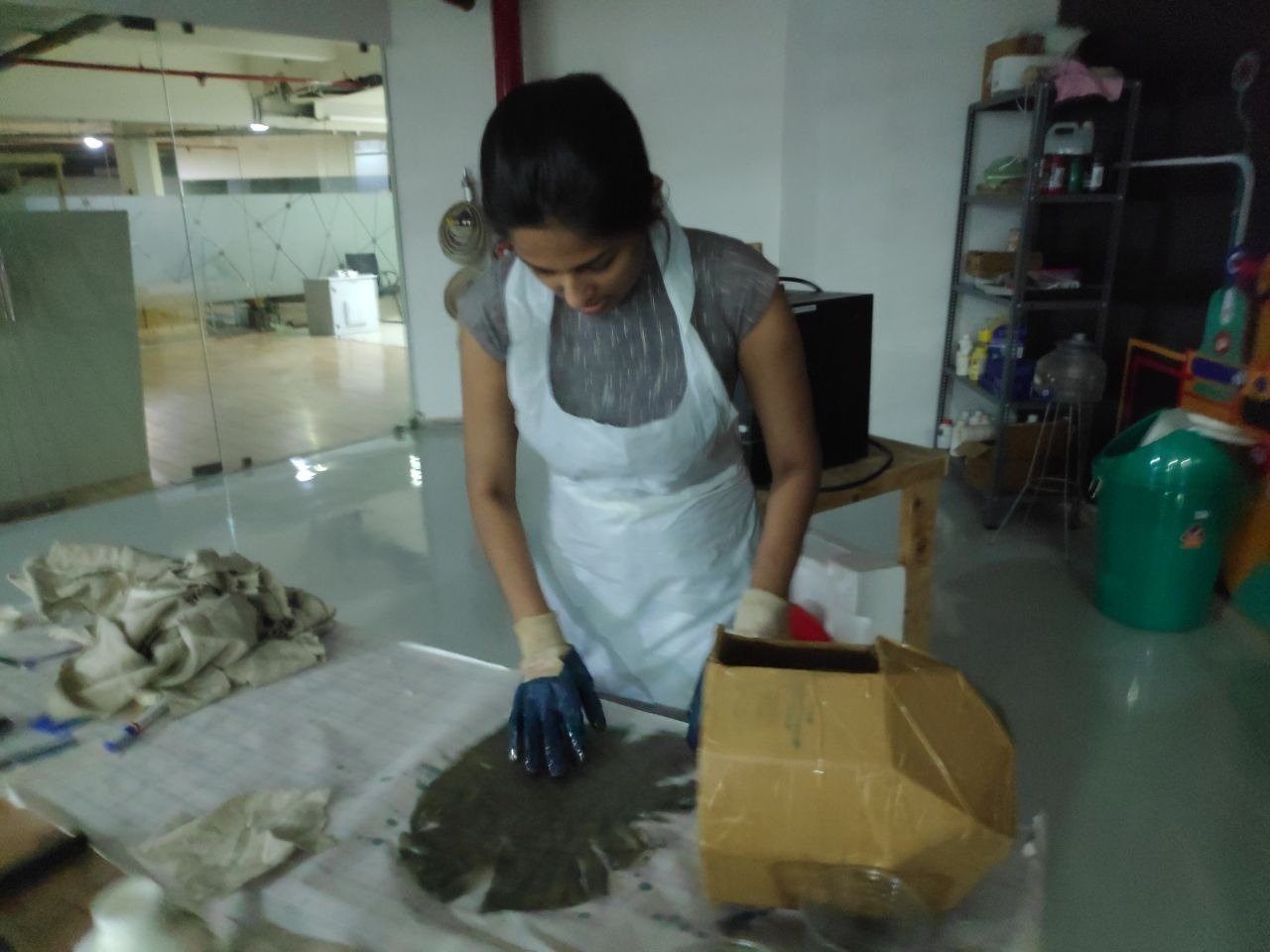
With Pola, my work on transforming invasive water hyacinth into useful materials has brought me into contact with a different set of barriers.
Developing a material is one challenge.
Accessing machinery, conducting repeatable experiments, obtaining testing support, building manufacturing capacity and turning that material into a viable business are entirely different challenges.
This is especially difficult for independent researchers who do not belong to universities or well-funded companies.
For women without inherited wealth or strong institutional backing, the difficulty multiplies.
A fellowship may provide recognition. A grant may fund an experiment. An incubator may provide a workspace.
But what happens between these fragments of support?
Who pays for the failed prototypes?
Who provides access to specialised equipment?
Who helps negotiate with manufacturers?
Who supports the founder during the long period when the technology is not yet commercially viable?
Who connects her to researchers who can answer questions beyond her own expertise?
These are not glamorous questions.
They are the questions that determine whether an invention ever becomes a business.
I have been fortunate to receive fellowships and support from institutions including the Royal Academy of Engineering and the Motwani Jadeja Foundation. These experiences have been enormously valuable.
But they have also made me more conscious of how many capable women never enter the rooms where such opportunities become available.
Recognition is meaningful. Access is transformative.
And sustained access matters more than a single moment of recognition.
07 / Stop Celebrating Exceptions. Build the Conditions for Everyone Else.
I am deeply interested in creating a different kind of support system for women innovators.
Not another organisation whose primary activity is holding conferences about empowerment.
Not another programme that teaches women to become confident without addressing the structures that undermine their independence.
And not an ecosystem where women are expected to demonstrate exceptional resilience simply to access opportunities that others take for granted.
I imagine a network where a woman developing a new material can find a laboratory and a materials scientist.
Where a craft entrepreneur can work with an engineer to improve a production tool.
Where someone returning to work after years of caregiving can rebuild technical skills without being treated as a beginner in life.
Where a neurodivergent founder can receive support without having to disguise how she works.
Where young girls encounter engineering, machines, tools and experimentation as ordinary possibilities rather than unfamiliar territories.
Where women can find collaborators, investors, mentors and peers who take their ambitions seriously.
And where access is not dependent on being born into the right family, studying at the right institution or knowing the right people.
I do not believe every woman needs to become an entrepreneur.
Nor should entrepreneurship be presented as a substitute for secure employment, public services or economic rights.
But every woman who wants to build something should have a genuine opportunity to try.
For years, I have worked by identifying what is missing between people, institutions, knowledge and resources—and finding ways to connect them.
Increasingly, I have come to see this not merely as a professional skill, but as the foundation for the kind of institution I want to help build.
An institution that does not simply celebrate innovation after it succeeds, but helps create the conditions in which innovation can begin.
Because the real measure of progress is not how many extraordinary women we can put on a stage.
It is how many women no longer have to be extraordinary just to get through the door.
We do not need more stories about women overcoming impossible odds.
We need to make the odds less impossible.
