Notes from Fab Academy on rediscovering electronics through things that sense, move and communicate.
01 / I HAD LEARNED THIS BEFORE
Electronics wasn’t new to me when I joined Fab Academy.
I had studied Information Technology Engineering between 2003 and 2008. My coursework included subjects such as Linear Integrated Circuits, Signals and Systems and Digital Signal Processing.
I passed the exams.
But much of what remained in my memory was equations, block diagrams and theories learned because they had to be reproduced in an examination.
I understood electronics academically. I wasn’t particularly confident about building with it.
More importantly, I didn’t find it very interesting.
I knew the theory. I didn’t yet see the possibilities.
02 / THEN NEIL DREW THE SYSTEM DIFFERENTLY
Fab Academy reorganised electronics in my head.
Neil Gershenfeld’s lectures weren’t simply about components or equations. They kept returning to what those components could do.
Inputs.
Outputs.
Networking.
Embedded programming.
Suddenly these weren’t disconnected engineering subjects. They were parts of a system.
THE 23 STEPS
03 / START WITH WHAT YOU WANT TO HAPPEN
The questions became surprisingly ordinary.
What do I want to know?
Is something there?
↓
What can sense it?
A sensor.
↓
What do I want to happen?
Something should move.
↓
What can make it move?
A motor.
↓
How does the input tell the output?
Communication + code.
This sounds almost embarrassingly simple.
But that simplicity changed everything for me.
Instead of beginning with electronics and trying to understand where I might use it, I could begin with what I wanted an object to do and work backwards.
04 / INPUT
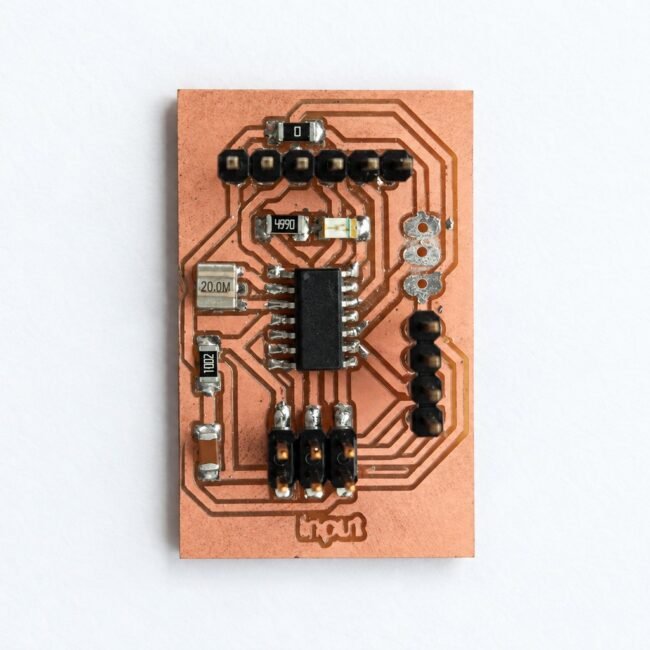
What do I need the object to notice?
Movement. Distance. Light. Temperature. Touch.
Once the question was framed that way, a sensor stopped being an electronic component I had to understand for an examination.
It became a way of asking the physical world a question.
Wood textile
05 / OUTPUT
Then came the opposite question.
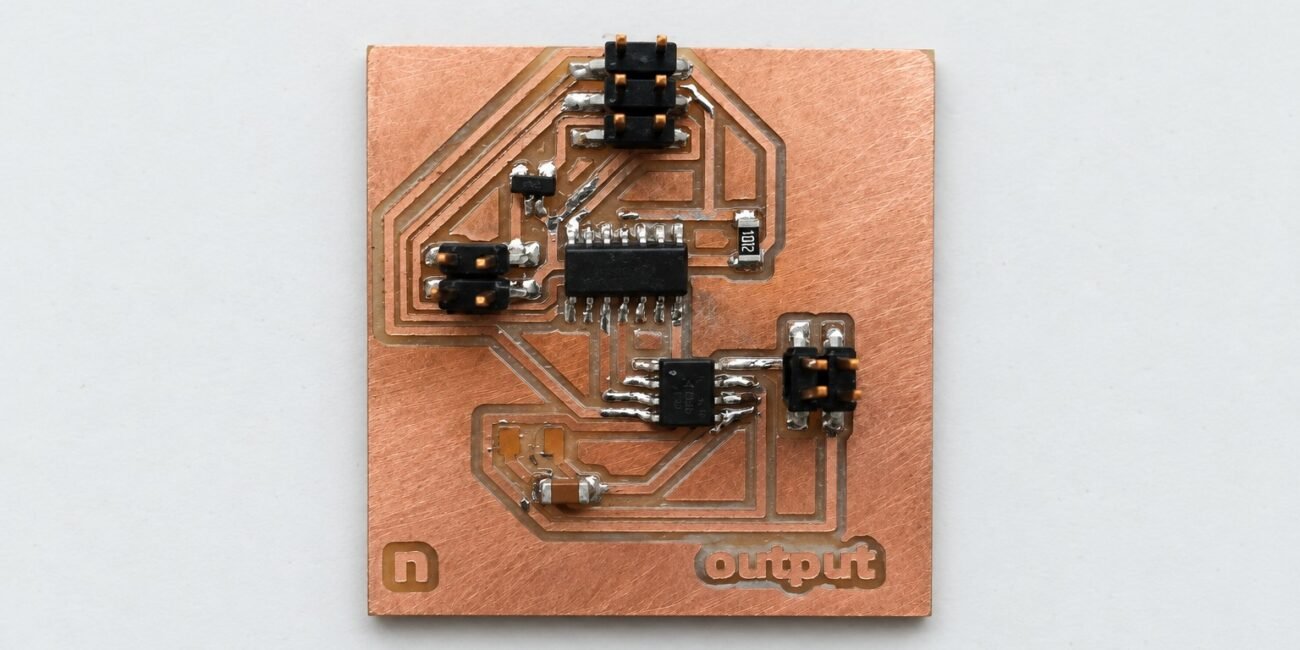
What do I want the object to do?
Move something. Turn something. Light something. Make a sound.
The output device became the physical answer to the input.
06 / AND THEN THEY HAD TO TALK
A sensor detecting something wasn’t particularly useful if nothing happened afterwards.
A motor turning wasn’t particularly interesting if it didn’t know when to turn.
The pieces had to communicate.
Networking and programming stopped feeling like separate subjects. They became the instructions connecting one event to another.
SOMETHING HAPPENS
↓
SENSE
↓
DECIDE
↓
COMMUNICATE
↓
ACT
Electronics had become a conversation between an object and its surroundings.
07 / THE CIRCUIT BECAME PHYSICAL
Fab Academy also removed another psychological barrier.
Circuits weren’t things that had to arrive inside mysterious green boards manufactured somewhere else.
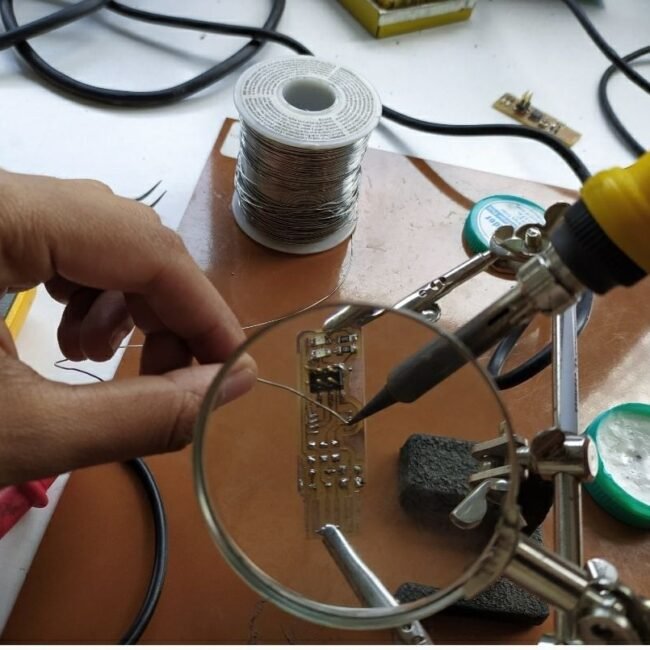
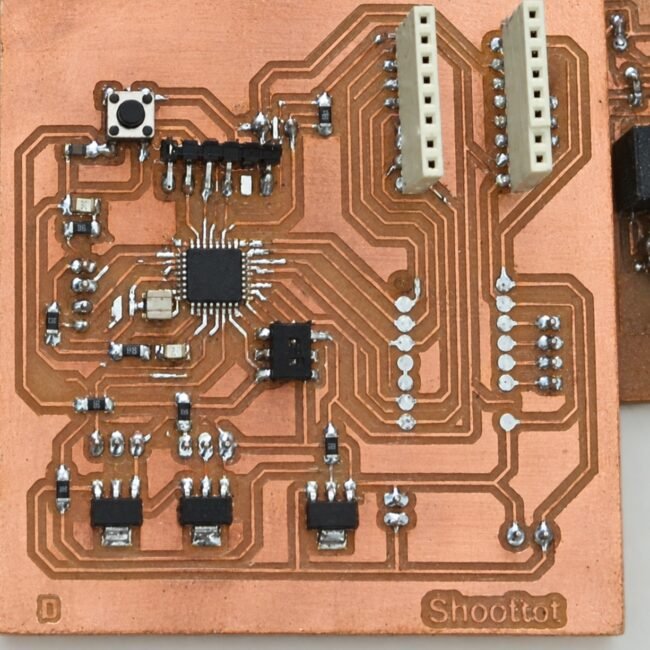
I could design one.
Mill it.
Solder it.
Program it.
Break it.
Debug it.
And make another one
08 / THE CAT MADE IT REAL
The exercises became meaningful when I applied them to a problem I actually cared about.
I wanted to automate a cat-litter box.
Suddenly the questions weren’t academic.
How does the machine know the cat is there?
How does it know the cat has left?
What should happen afterwards?
What needs to move?
How far?
How does it know when to stop?
Each question led naturally to another component, another experiment and another piece of code.
ShooBot was where electronics stopped being a subject and became a design material.
09 / ENGINEERING, REARRANGED
THEN
Linear Integrated Circuits
Signals and Systems
Digital Signal Processing
Embedded Systems
Networking
NOW
What do I want to sense?
What can sense it?
What needs to happen?
What can make it happen?
How do the two communicate?
The engineering hadn’t become less sophisticated.
My way into it had become simpler.
10 / WHAT I CARRIED BACK
01
What do I actually want the object to sense?
02
What should happen when it senses it?
03
What is the simplest way to connect those two events?
04
Do I need electronics here at all?
FIELD NOTES → ONGOING PRACTICE
I had studied electronics before. Fab Academy made me want to use it.
The equations hadn’t disappeared. Neither had the engineering.
What changed was my starting point.
I no longer began with a circuit and wondered what it could do.
I could begin with a behaviour:
I want to know this.
I want this to happen.
How do I connect the two?
Once I could see electronics that way, it stopped feeling like a subject I had once studied.