
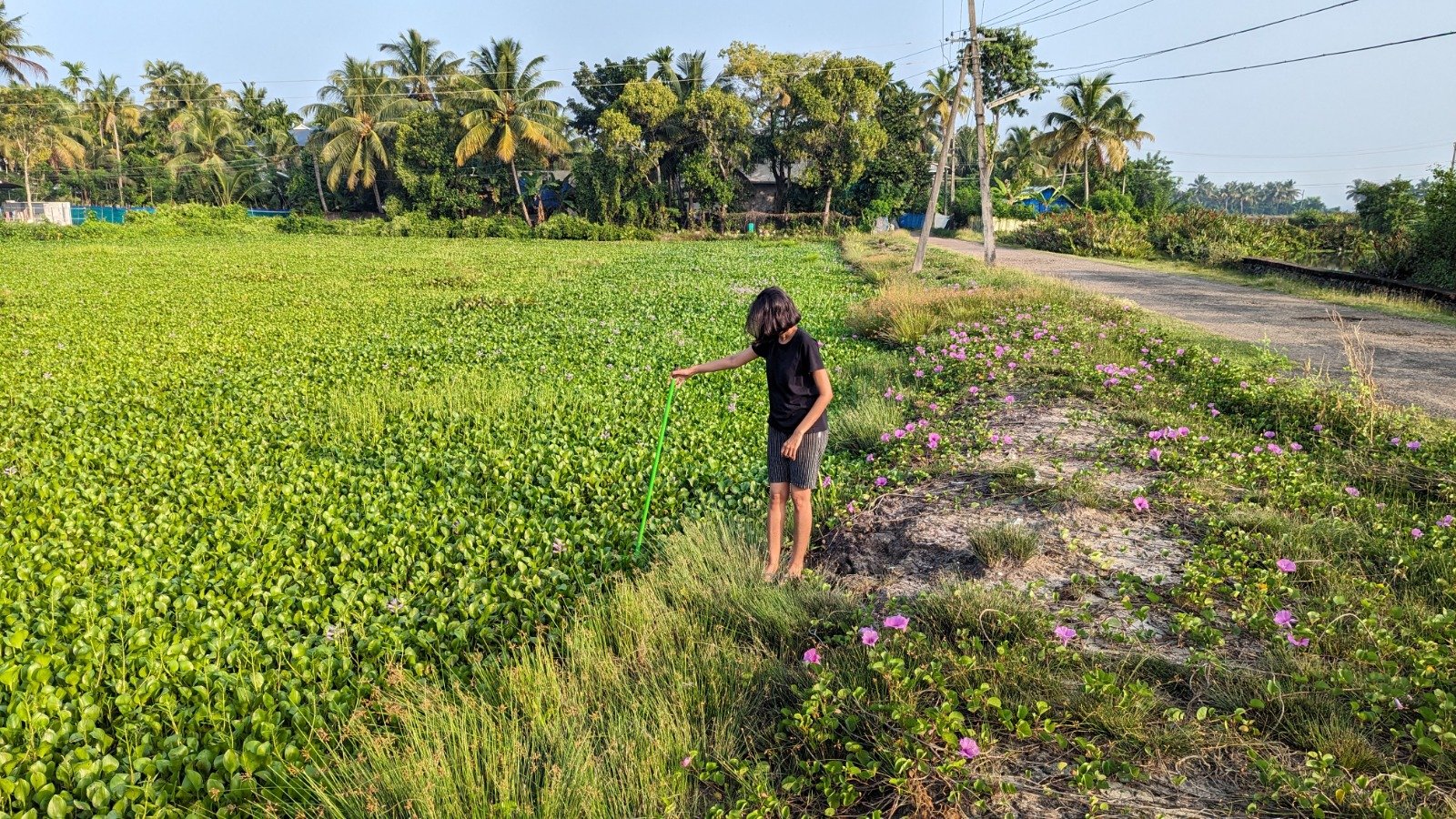
The Politics of Water Hyacinth Removal
Who pays to clear an invasive plant, who profits from its removal, and why does it keep coming back?
On Vembanad Lake in Kerala, water hyacinth is not an abstract environmental problem.
It is a plant that gathers around boats, blocks narrow waterways, interferes with fishing and accumulates against the infrastructure that connects communities to the mainland.
For someone travelling across the lake every day, removing water hyacinth is an immediate necessity. A cleared waterway means reaching school, work, a hospital or a market without having to fight through floating vegetation.
For a government department, however, the same plant can represent a maintenance contract, an environmental target or an expenditure that must be justified.
For a researcher, it is an invasive species whose growth reflects a complex set of ecological conditions.
For an entrepreneur like me, working on turning water hyacinth into biomaterials, it is also a potential raw material.
We are all looking at the same plant.
But we are not necessarily looking at the same problem.
That is where the politics of water hyacinth removal begins.
01 / The Plant Is Visible. The Problem Is Often Not.
Water hyacinth is an extraordinarily visible symptom of ecological disturbance.
Its floating mats can cover waterways so completely that the water beneath disappears from sight. Removing those mats creates an equally visible result: open water.
It is easy to photograph the transformation.
Before: a canal covered in vegetation.
After: a clear channel.
But does that mean the waterbody is healthier?
Water hyacinth thrives under conditions that often include nutrient enrichment, stagnant water and altered hydrology. In Vembanad, researchers have connected aquatic weed proliferation to sewage, agricultural runoff, land reclamation, saltwater barrages and restrictions on natural tidal flushing.
These are not problems that can be solved simply by harvesting plants.
Removing water hyacinth without addressing the conditions that favour its growth can become an endless cycle of clearance and recolonisation.
The plant returns because the environment remains favourable to it.
This raises an uncomfortable question.
Are we managing the invasive species, or merely managing its visibility?
A clean-looking canal can still carry polluted water. A newly opened waterway can remain ecologically degraded. A successful removal operation may improve access without reversing the processes that allowed the invasion to expand.
These are different outcomes, and we should be careful not to confuse them.
02 / Who Is Responsible for the Water?
A lake does not organise itself according to administrative boundaries.
Its water moves through rivers, canals, wetlands, agricultural landscapes, settlements and industrial areas.
Government responsibilities, however, are divided.
One agency may manage irrigation. Another may be responsible for navigation. Local governments may handle waste and sanitation. Environmental authorities oversee pollution and ecological protection. Fisheries and agricultural departments have their own mandates.
Water hyacinth moves across all these jurisdictions.
The responsibility for removing it does not always move as easily.
A local authority might clear a canal only for plants to drift in from a neighbouring waterbody. A community might repeatedly remove vegetation while pollution continues entering from elsewhere in the catchment.
The immediate burden falls on the people whose livelihoods and mobility depend on that water.
The larger causes may lie far beyond their control.
In Kerala, this institutional complexity is not merely theoretical. Government and tribunal proceedings concerning Vembanad have discussed mechanical removal, ecological restoration, commercial utilisation and the involvement of multiple agencies.
The challenge is not simply identifying someone to remove the plant.
It is establishing responsibility for the condition of the waterbody after the removal is complete.
Who is accountable when the canal is cleared today and covered again six months later?
03 / Removal Is Work. Who Gets Paid?
We often describe water hyacinth removal as an environmental activity.
But it is also labour.
Someone has to enter the water, operate machinery, gather the plants, load the biomass, transport it, dry it and dispose of or process it.
Water hyacinth is bulky and contains a great deal of water. Moving large quantities of freshly harvested biomass is therefore a significant logistical challenge.
The work can be physically demanding, and the economics change considerably depending on how far the material must travel and what happens to it afterwards.
Who performs this labour?
Are local fishers and residents employed?
Are workers paid adequately and provided with safe equipment?
Do removal contracts reward the amount of vegetation collected, the area temporarily cleared or the sustained improvement of the waterway?
These distinctions matter.
A contract measured only by tonnes removed may not adequately reward prevention, long-term maintenance or ecological recovery.
A community that suffers from an invasive species should not automatically become a source of inexpensive labour for removing it.
At the same time, properly designed removal programmes can provide employment while improving navigation and local livelihoods.
In 2024, traditional fishers in Edakochi participated in a water hyacinth removal initiative in Vembanad, with the harvested biomass intended for processing into solid biofuel. The participating fishers were paid for removal work.
Such initiatives demonstrate the possibility of connecting local employment with biomass utilisation.
But they also invite a larger question:
Can the people who bear the ecological costs of an invasive species also share in the economic value created by managing it?
04 / When Waste Becomes a Resource, Who Owns It?
My work with Pola began with a material question.
Could an invasive aquatic plant become something useful?
I started exploring water hyacinth as a source of fibre and biomass for products including biodegradable cat litter, boards and other material applications.
The attraction is obvious.
Instead of treating harvested plants entirely as waste requiring disposal, perhaps we can turn some of that biomass into products with economic value.
If the products generate sufficient revenue, they might help finance repeated harvesting.
But the moment an invasive plant becomes a commercial resource, another set of questions appears.
Who owns the harvested biomass?
Who receives permission to collect it?
Who controls access to the waterways?
Who receives the processing contracts?
Who owns the technologies developed from it?
And who receives the financial benefits?
These questions become particularly important when public funds pay for removal but private businesses benefit from the resulting raw material.
There is nothing inherently wrong with a private enterprise using publicly removed biomass. It may reduce disposal costs and create useful products.
But the arrangement should be transparent.
A viable system needs to distinguish between the value of the biomass, the cost of ecological management and the contribution of public infrastructure and labour.
Otherwise, circular-economy language can obscure the actual distribution of costs and benefits.
A material can be commercially valuable without the system producing it being socially equitable.
05 / The Paradox of Building a Business Around an Invasive Species
This is the contradiction I find most interesting in my own work.
If I build a successful business using water hyacinth, I need a reliable supply of raw material.
But if the ecological objective is to control the invasive species, successful management should eventually reduce its abundance.
What happens to the business then?
Would a manufacturing enterprise built around water hyacinth become dependent on the continued existence of the very problem it claims to help solve?
This does not mean businesses should avoid invasive biomass.
It means their incentives must be designed carefully.
A responsible material enterprise should not need the ecological problem to become worse in order to grow.
It might process biomass from several affected locations, diversify into other locally available fibres or develop machinery capable of handling different feedstocks.
It could also participate in removal programmes where ecological priorities determine harvesting, rather than allowing manufacturing demand to determine how much invasive biomass should remain available.
For Pola, this question matters.
I am interested in developing useful materials and the machinery needed to process them. But I do not want the commercial success of those materials to be confused with proof of ecological restoration.
Producing a board from water hyacinth is a material achievement.
Selling that board is a commercial achievement.
Removing biomass from a waterway is a management activity.
Restoring the ecological functioning of the lake is something larger.
They may support one another, but they are not the same accomplishment.
06 / A Circular Economy Is Not Automatically a Restorative Economy
The circular economy has become an attractive framework for environmental entrepreneurship.
Take waste. Transform it. Create value. Reduce disposal.
For water hyacinth, proposed applications range from handicrafts and compost to bioenergy, absorbents, packaging and engineered materials.
Some applications are technologically promising. Others face difficulties involving production costs, durability, contamination, processing energy or market demand.
Not every product that can be made from water hyacinth should necessarily be manufactured at scale.
A material derived from an invasive plant is not automatically environmentally sustainable.
What if harvesting and transport consume excessive energy?
What if processing requires large quantities of water or chemicals?
What if the harvested plants contain contaminants accumulated from polluted waterways?
What happens to the product at the end of its life?
And how much of the standing biomass can the enterprise realistically absorb?
These questions require testing, lifecycle assessment and transparent accounting.
They cannot be answered by calling a product biodegradable or natural.
There is also a difference between creating a market for invasive biomass and achieving ecological control.
A small craft enterprise may provide valuable livelihoods while consuming only a tiny proportion of the plants in a large infested lake.
That is not a failure. It may be an excellent livelihood initiative.
But it should not be presented as a lake-wide restoration solution unless the evidence supports that claim.
Similarly, a large industrial processing facility may consume substantial quantities of biomass without addressing sewage, nutrient loading or disrupted water circulation.
Circularity describes how materials move through an economy. Restoration asks whether the ecosystem is actually recovering.
We need to measure both.
07 / Who Gets to Decide What a Healthy Lake Looks Like?
Environmental management is often discussed through scientific and administrative categories.
Invasive species.
Nutrient loading.
Dissolved oxygen.
Biomass removal.
Water quality.
These measures are essential.
But the people living around a lake experience its condition through other measures.
Can the boat reach the jetty?
Can a fisher cast a net?
Can children travel to school?
Can a family access clean drinking water?
Are the species that once supported local livelihoods still present?
These questions are ecological, social and economic at the same time.
Around Kakkathuruth in Vembanad, I have become increasingly conscious of how closely water, mobility and everyday life are connected.
A boat is not simply transport infrastructure. It is a connection to employment, education and healthcare.
When floating vegetation interferes with that connection, removal becomes an immediate public need.
Residents should not have to wait for a comprehensive restoration programme before a blocked waterway is made usable.
But their urgent needs should not be used to justify treating temporary clearance as a complete environmental solution.
Both can be true.
The waterway needs to be opened.
And the conditions causing repeated infestation need to be addressed.
Community participation is therefore more than asking residents to volunteer for cleaning campaigns.
It means including them in decisions about priorities, timing, labour, compensation, disposal and long-term monitoring.
A lake is not an empty landscape awaiting expert intervention.
It is a lived environment.
08 / What Would Successful Removal Actually Mean?
I think we need to ask more demanding questions of water hyacinth management.
Not simply: How many tonnes were removed?
But: How long did the waterway remain accessible?
Did the infestation return?
Did water quality improve?
Were the causes of nutrient enrichment reduced?
Did fisheries or native aquatic habitats recover?
How much did repeated management cost?
Who received wages and economic benefits?
Where did the harvested biomass go?
Was processing environmentally safe?
Did local communities have a meaningful role in deciding what happened?
These questions shift attention from a single visible operation to the performance of the entire system.
A successful programme may need several approaches working together: immediate mechanical removal where access is obstructed, appropriate biological control, pollution reduction, improved water circulation, ecological monitoring and responsible utilisation of harvested biomass.
Different waterbodies will require different combinations.
There is no reason to assume that one machine, one product or one enterprise can solve the problem everywhere.
And there is no reason to assume that the solution must be entirely governmental or entirely commercial.
Public agencies, researchers, manufacturers, local communities and environmental organisations may all have roles.
The challenge is designing a system in which their responsibilities and incentives align with the health of the waterbody.
09 / The Plant Is Not the Whole Problem
Water hyacinth is an invasive species. Its proliferation can damage aquatic ecosystems and disrupt livelihoods.
It needs to be managed.
But it is also a plant responding to environmental conditions.
It did not create the sewage entering the lake.
It did not build the structures that changed water circulation.
It did not decide how land would be reclaimed, how agricultural runoff would be managed or which communities would receive functioning sanitation infrastructure.
Those are human decisions.
And that is why the politics of water hyacinth removal cannot end with the plant.
The deeper question is what we are willing to change about the systems that allow it to proliferate.
I began working with water hyacinth because I wanted to discover what could be made from it.
That question remains important to me.
But the longer I work with the material, the more I find myself returning to another question.
What would it take for a business built around removing an invasive species to contribute to a future in which that species is no longer an overwhelming problem?
Perhaps the measure of success is not how much water hyacinth we can harvest forever.
Perhaps it is whether the waterbody eventually needs us to harvest less.
The goal should not be to build an economy that depends on a damaged lake.
It should be to build an economy that helps the lake recover.
