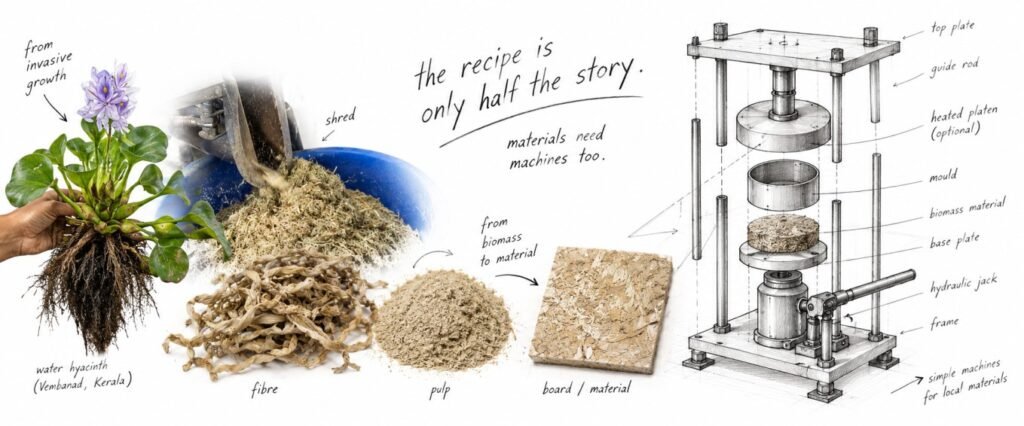
What tools do we need to transform biomass into useful materials?
01 — Materials Need Machines Too
A material is shaped by the tools that make it.
Material research is often presented as a search for ingredients and formulations. But once a material leaves the laboratory, another question appears: what machine can actually make it?
Working with unconventional biomaterials has repeatedly brought me to the same problem. Fibres need to be separated. Wet biomass needs to be dewatered. Materials need to be mixed, pressed, heated, extruded or formed. Existing industrial equipment is often too large, expensive or designed for completely different materials.
My material research therefore increasingly becomes machine research.
02 — Start With the Material
Different material behaviours demand different machines.
A machine should not be designed independently of the material passing through it.
Wet biomass behaves differently from dry fibre. Long fibres behave differently from powder. A paste needs different handling from a sheet. Pressure, temperature, moisture, particle size and flow all change what a material can become.
Instead of asking “Which machine can I use?”, I begin with:
What does this material need the machine to do?
This changes the design process from adapting material to existing equipment to developing material and machine together.
03 — Translate Making Into Actions
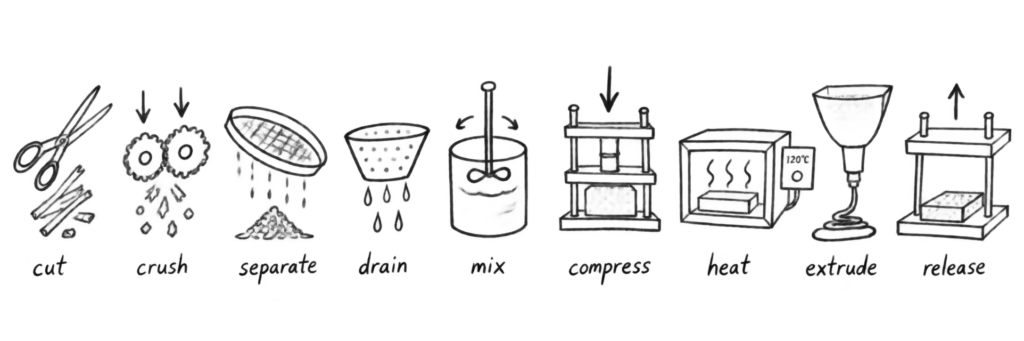
Before designing the machine, break the process into verbs.
A complicated manufacturing process becomes easier to understand when reduced to physical actions:
“Compress” raises questions about force, platen area and movement. “Heat” introduces temperature distribution and control. “Extrude” requires understanding viscosity, pressure and nozzle geometry. “Release” introduces mould design, draft and surface behaviour.
The machine begins as a sequence of actions, not an object.
04 — Pressure Changed the Question
From pressing a sample to designing a press.
Early material experiments can be made with whatever tools are available. But inconsistent tools produce inconsistent samples.
Working with pressed biomass made pressure itself a research variable: How much force is actually being applied? Is it distributed evenly? What happens when heat is introduced? How does water escape? How can the material be removed without damaging it?
Those questions led from improvised pressing to the development of a compact Biomass Press—and subsequently toward heated platens, interchangeable moulds and pressure and temperature control.
The machine is no longer merely equipment used to conduct the experiment. It becomes part of the experiment.
05 — One Process, Different Scales
Laboratory equipment is not automatically appropriate infrastructure.
A process that works at sample scale may become impractical when kilograms of wet biomass arrive every day.
This introduces another set of design variables:
throughput · energy · cost · repairability · portability · operator effort · available skills
For locally harvested materials, the most appropriate machine may not be the fastest or most automated one. A smaller machine that can be fabricated, repaired and modified locally can sometimes make more sense than centralised industrial equipment.
This is where my interest moves from machines for experiments toward machines for distributed production.
06 — The Machine Is a Material Decision
Tools determine what becomes possible.
A shredder determines fibre length. A mould determines geometry. A press controls density and thickness. An extruder influences flow and resolution. Drying equipment affects moisture and processing time.
So a material cannot always be described independently of its manufacturing system.
This creates a feedback loop:
MATERIAL → PROCESS → MACHINE → MATERIAL
Change one, and the others change with it.
Rather than treating machines as neutral equipment at the end of material development, I am interested in designing materials, processes and machines as one system.
07 — What I Am Trying to Build
A small vocabulary of machines for unconventional materials.
The longer-term research is not about creating one universal machine. It is about developing adaptable tools for transforming locally available biological materials at an appropriate scale.
That might include equipment for dewatering, shredding, fibre preparation, pulping, mixing, pressing, controlled heating and extrusion—machines simple enough to understand and modify, but precise enough to produce repeatable materials.
The research question becomes:
Can we design the machine at the same time as we design the material?
And beyond that:
Can both be designed around the place where the material comes from?